Today’s job market favors the job seeker. Most organizations offer current employees advancement opportunities; however, are they serious about giving internal candidates a chance? Does your organization provide a satisfying internal application process, or do you discourage current employees from applying? If you do discourage internal hires, the result could be that good talent will look elsewhere.
When people choose your organization, they expect that you will follow through with your promises. If your organization emphasizes internal mobility and you do not follow through, the psychological contract is broken. A psychological contract is an informal contract between the employer and the employee. The employer hires the employee and expects the employee to perform their job per their advertised skill set. The employee expects the employer to provide all the benefits they advertised through the entire hiring process. When this contract is broken, the result is often a disillusioned employee or an unsatisfied employer. A disillusioned employee will look for another organization. I offer the following process to ensure that your internal hiring process proves that you are serious about promoting opportunities from within.
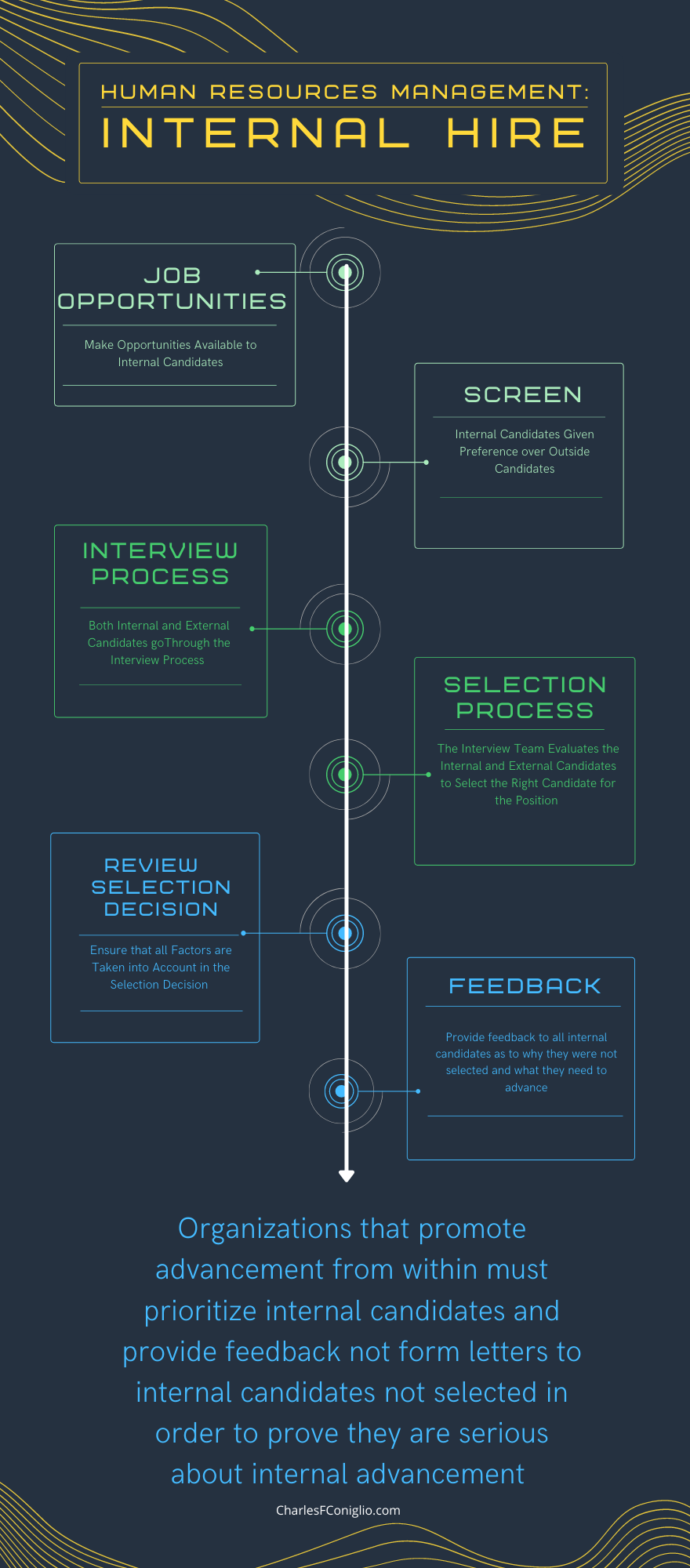
Job Opportunities: All job opportunities should be offered internally as well as externally. I suggest offering the opportunity to internal candidates first before going outside. If your organization has a workforce planning system, internal candidates can be found by a skill search. If not advertising internally will identify current employees that meet the job description, fostering employee engagement and lower recruitment costs.
Screen: During the screening process, priority should be given to internal candidates. Internal candidates already understand your organization and what you do. The fact that they are applying indicates that they want to stay with your organization. I suggest your organization have a published policy to give preference to internal applicants. Establishing an internal applicant preference policy indicates to internal and external candidates that your organization is serious about providing growth opportunities to current employees.
Interview Process: Both internal and external candidates should be interviewed per your organization’s processes. Fairness in the interview process is essential to avoid the appearance of violating equal opportunity laws.
Selection Process: After the interview process is complete, a selection is made by comparing all factors and choosing the best fit for the organization based on your process.
Review Selection Decision: This is an added step to promote internal hires and maintain employee engagement in the process. A review team is charged with evaluating the selection process results to determine if all internal candidates were evaluated fairly. The review team ensures that reasons for not selecting the internal candidates are documented for use in the Feedback Stage.
Feedback: Feedback is the most critical stage of this process. If your organization only provides a form letter to an internal employee indicating that they were not selected, no one will believe you are serious about hiring internally. Providing feedback to internal candidates can be time-consuming, especially if there are many applicants; however, it is essential. Internal candidates expect feedback as to why they were not selected, especially if interviewed. The interview is an excellent time to provide feedback. If, after talking to the internal candidate, it is apparent to the interviewer that it’s not a good fit, the interviewer should be honest with the candidate and tell them. If the interviewer closes the interview leaving the impression that the candidate is in the running for the position and then no feedback is provided, it leaves the candidate wondering what went wrong. Worse case, they feel that the organization was looking all along at an outside candidate. One other point, an internal candidate most likely has access to organizational charts and will find out who was hired. They would compare skill sets and experience levels and determine for themselves if they were treated fairly. If the internal candidates were provided feedback, they might disagree; however, they understand why the organization believed they were not a good fit. If the feedback included what they could do in the future to qualify for a similar position, it would most likely motivate the employee to increase their skillset and continue to have faith in the internal hire process.